Tripping Circuit Breaker Troubleshooting: What to Check First
Breakers trip for a handful of reasons, and a few careful minutes of checking can tell you which one you're dealing with.
October 7, 2026 · 4 min read
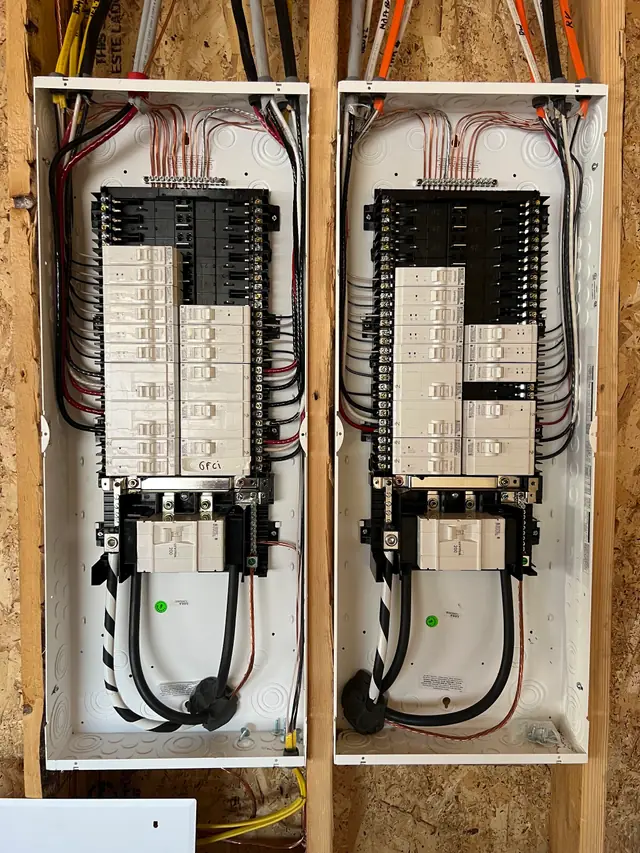
Nobody enjoys standing in a dark kitchen, flashlight in hand, wondering why the power went out again. A tripping breaker is annoying, but it's also information. The breaker is telling you something about the circuit, and if you know how to listen, you can often narrow it down before anyone has to come out.
This is the same order we work in when we get a call about a tripping breaker. Some of it you can do yourself. Some of it you shouldn't, and we'll be plain about where that line is.
The five usual reasons a breaker trips
- Overload. Too much is running on one circuit at once. A space heater, a microwave, and a toaster on the same kitchen circuit is the classic example. The breaker trips because the circuit is warming up under the load.
- Short circuit. A hot wire touches a neutral or another hot wire, usually because of damaged insulation, a loose connection, or a nail or screw through a cable. A short trips the breaker instantly, often with a pop.
- Ground fault. Current is leaking somewhere it shouldn't, often through moisture. This is common in bathrooms, kitchens, garages, and outdoor outlets.
- A failing appliance. The wiring is fine, but a motor or heating element inside a device is shorting out or drawing too much. The breaker trips when that device turns on.
- A failing breaker. Sometimes the breaker is worn out and trips under loads it used to handle.
Overloads are the most common and the easiest to fix. The others range from simple to serious, and the way a breaker trips usually gives you a clue.
Pay attention to how it trips
A breaker that trips after running for a while, say when the dryer has been going for twenty minutes or when you start the second appliance, usually points to overload or a device that's drawing too much. A breaker that trips the instant you reset it, or the instant you flip a switch or plug something in, points to a short or ground fault. A breaker that trips randomly, with nothing obvious going on, can be a loose connection, moisture, or a worn breaker.
Write down what was running and what you were doing when it tripped. That small note saves a lot of time, whether you solve it yourself or hand it to an electrician.
Safe steps a homeowner can take
- Find the tripped breaker. In most panels the handle sits in the middle position or toward off. Look for the one that doesn't match the others.
- Unplug everything on that circuit and switch off the lights. Use the panel labels to find out what's on it, and remember labels are sometimes wrong.
- Push the handle fully to off, then back to on. Many breakers have to go all the way to off before they'll reset.
- If it holds, plug things back in one at a time, waiting a few minutes between each. If it trips when one device comes back, you've found the culprit, and the fix is to move that load or repair or replace that device.
- If an outlet has test and reset buttons, press reset. A tripped GFCI outlet in a garage or bathroom can cut power to other outlets down the line.
Do all of this with dry hands and with your body clear of the panel. Open only the labeled door, never the cover behind it.
What not to do
Don't put in a bigger breaker because the one you have keeps tripping. It's the single most dangerous shortcut we see. The wires in your walls are sized to match the breaker, so a bigger breaker lets the wire heat past what it was built for, and that heat happens inside the wall where you can't see it. Don't keep resetting a breaker that trips right away either. Each reset into a short is a small jolt to the breaker and the wiring.
Where DIY ends
Stop and call a licensed electrician if the breaker trips with everything unplugged, if it trips again right after you reset it with the loads removed, or if you've found a device that trips it and replacing the device doesn't help. Stop if any outlet, switch, or breaker is warm, discolored, or smells like burning. Stop if you hear buzzing or sizzling, if the trouble seems to follow rain or wet weather, or if the lights flicker or dim whenever something big starts up.
Those signs can mean a loose connection, damaged wiring, or a failing panel, and finding those means opening up the electrical system, which is licensed work for good reasons. A loose connection that's making heat can look like nothing from the outside right up until it becomes a fire.
Older homes need special mention. If your house has an older panel that's running out of room, with circuits that handle every modern appliance and more devices than the house was ever wired for, repeated tripping may just mean the system has run out of capacity. That's a conversation about upgrading the panel or adding circuits, not about resetting breakers.
If you'd rather have someone look than keep guessing, call JJ & S Electric at (509) 504-5504 or send a note through the contact page. We cover all of Yakima County, we're in the office Monday through Friday from 7 to 5, and emergency calls get answered at any hour.
JJ & S Electric LLC, (509) 504-5504
Call (509) 504-5504More articles
How to Tell if a Circuit Breaker Is Going Bad
A breaker that trips is usually doing its job, but sometimes the breaker itself is the problem, and the signs are easy to spot once you know them.
Why Licensing and Insurance Matter When You Hire an Electrician
A license and proper coverage are the difference between a contractor you can hold accountable and a bargain that ends up costing more.